What Estate Managers Actually Do: The Real Responsibilities Behind Multi-Property Operations
Quick Answer: Estate manager duties include overseeing multi-property operations, coordinating vendors and staff, managing budgets, planning maintenance, and reporting to principals or family offices. These professionals operate at a strategic level, using AI-powered platforms to automate tracking while focusing on relationships and decision-making.
Estate Manager Job Description
An estate manager is the senior professional accountable for running a private estate: its properties, staff, vendors, budget, and physical assets. The job description spans five areas of responsibility, property and maintenance, staff and vendor management, finance and administration, lifestyle and events, and asset records and risk, with one person accountable for how they run as a whole. They report to the principal, family office, or chief of staff. Estate managers handle the complexity you don’t see: multiple properties, dozens of vendors, staff coordination, maintenance, and budgets, all while holding the service standards that reflect the principal’s expectations.
Core Estate Manager Duties Overview
| Responsibility Area | Key Duties | Time Impact Without Automation |
|---|---|---|
| Multi-Property Oversight | Coordinate maintenance, track expenses, ensure service standards | 15-20 hours/week |
| Staff Management | Hiring, scheduling, reviews, training across locations | 10-15 hours/week |
| Vendor Coordination | Invoice reconciliation, service documentation, performance tracking | 12-18 hours/week |
| Budget Management | Expense tracking, reporting to principals/family office | 8-12 hours/week |
| Maintenance Planning | Schedule tracking, warranty management, asset protection | 10-15 hours/week |
Primary Estate Manager Duties: Multi-Property Oversight
Among the most critical estate manager duties is overseeing daily operations across all your properties. Consequently, this means coordinating maintenance schedules, managing vendor relationships, tracking expenses, and ensuring each location meets your service standards.
Unlike property managers who focus on maintenance, or house managers who oversee single residences, estate managers operate at a strategic level. Furthermore, modern platforms like EstateSpace provide the unified visibility needed to track everything happening across multiple locations in real-time.
Essential Estate Manager Duties: Staff Management
Estate manager duties include hiring, training, and managing household staff across multiple properties. According to the Estate Management Network, this represents one of the most time-intensive aspects of the role.
Key responsibilities include:
- Coordinating schedules across multiple properties
- Conducting performance reviews and HR management
- Ensuring consistent service standards regardless of location
- Cross-training staff to control costs and reduce turnover
Additionally, building repeatable systems for estate teams helps maintain consistency even as staff changes or grows.
Critical Estate Manager Duties: Vendor Coordination
Estate manager duties extend to coordinating dozens of vendors across multiple properties. However, when invoices don’t match quotes or service records are scattered across email chains, professionals spend hours reconciling instead of managing.
Common Vendor Management Challenges
| Challenge | Traditional Approach | AI-Powered Approach |
|---|---|---|
| Invoice doesn’t match quote | Manual comparison, email follow-up | Automatic flagging before payment |
| Missing service documentation | Chase vendor for records | AI prompts for documentation |
| Warranty expiration tracking | Spreadsheet reminders | Predictive alerts before expiration |
| Budget variance identification | Month-end reconciliation | Real-time spending alerts |
Moreover, AI estate management workflows automate vendor tracking and documentation, eliminating the manual chase. The Private Service Alliance emphasizes that vendor management extends beyond coordination to include negotiation, quality control, and relationship management.
Financial Estate Manager Duties: Budget Management
Among the most demanding estate manager duties is managing budgets and expenses across all properties. Therefore, professionals track spending, identify cost-saving opportunities, and report financial performance to principals or family offices.
Without unified systems, this means pulling data from multiple sources, reconciling invoices manually, and building reports from scratch. In contrast, property management budget software eliminates the manual work, giving instant visibility into spending patterns and budget variances.
Protective Estate Manager Duties: Maintenance Planning
Preventative maintenance represents crucial estate manager duties that protect asset value. Specifically, professionals plan regular maintenance, track warranties, manage repairs, and ensure nothing expires without notice.
Reactive vs Preventative Maintenance Approaches
| Approach | Process | Outcome | Cost Impact |
|---|---|---|---|
| Reactive Maintenance (What to Avoid) | Wait for equipment to fail → Emergency repairs required | Disrupted operations, principal frustration | Higher costs, unpredictable expenses |
| Preventative Maintenance (Best Practice) | Schedule regular service → Catch issues early | Planned maintenance, peace of mind | Lower costs, predictable budgets |
Furthermore, preventative maintenance in estate management reduces costs by catching issues before they become expensive problems. Similarly, modern AI property maintenance assistants predict maintenance needs before systems fail.
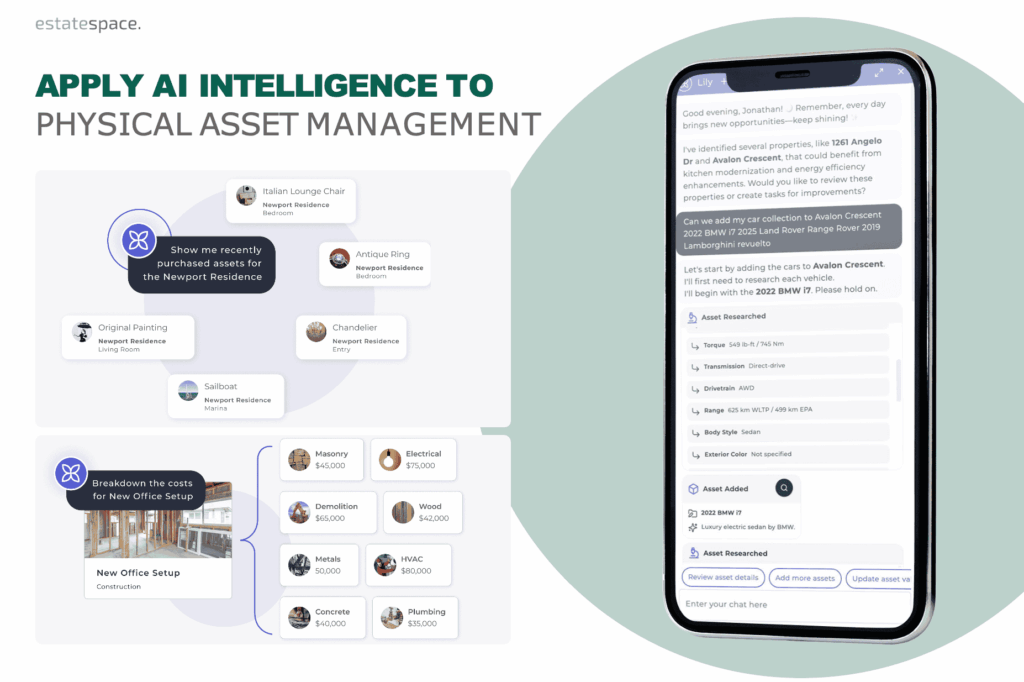
How AI Workflows Transform Estate Manager Duties
Traditional approaches to estate manager duties consume 55-80 hours per week on manual tracking, data compilation, and vendor coordination. However, AI workflows automate the routine work, giving professionals time for strategy and relationships.
The system alerts automatically when maintenance schedules come due. Likewise, AI flags warranties before they lapse as expiration approaches. Additionally, alerts trigger immediately whenever spending exceeds budgets. AI estate management workflows eliminate tracking that used to consume entire days.
The AI estate management platform learns from your operations, consequently getting smarter over time about what needs attention and when.
Time Savings: Manual vs AI-Powered Operations
| Task Category | Manual Approach | AI-Powered Approach | Time Saved |
|---|---|---|---|
| Vendor invoice reconciliation | 12-18 hrs/week | 2-3 hrs/week | 10-15 hrs/week |
| Maintenance tracking | 10-15 hrs/week | 1-2 hrs/week | 9-13 hrs/week |
| Financial reporting | 8-12 hrs/week | 1-2 hrs/week | 7-10 hrs/week |
| Staff coordination | 10-15 hrs/week | 3-4 hrs/week | 7-11 hrs/week |
| Total Weekly Savings | 40-58 hrs/week |

EstateSpace: Purpose-Built for Estate Manager Duties
EstateSpace is the first AI-powered platform designed specifically for executing estate manager duties across multiple locations. Unlike accounting software retrofitted for wealth management, EstateSpace was built by operators who performed these responsibilities for 16 years.
Platform Capabilities Comparison
| Feature | Traditional Approach | EstateSpace Solution |
|---|---|---|
| Asset Visibility | Spreadsheets across 5+ systems | Unified platform for all assets |
| Maintenance Tracking | Manual calendar reminders | AI-powered predictive alerts |
| Vendor Management | Email chains and folders | Automated tracking and documentation |
| Financial Reporting | Manual compilation (8-12 hrs) | Automated generation (minutes) |
| Principal Access | Request reports, wait days | Real-time dashboard access |
EstateSpace brings everything into one platform. Properties, vehicles, art, aircraft, wine collections, jewelry. As a result, family offices and asset managers finally have real-time visibility across their entire portfolio without manual data compilation.
The platform handles routine estate manager duties automatically:
- Maintenance alerts and scheduling
- Warranty expiration notifications
- Budget variance identification
- Vendor performance monitoring
- Documentation completeness checking
Therefore, estate management control means having visibility and systems that support decision-making, not heroic manual effort. Similarly, estate management clarity comes from systems that make excellence visible.
The Professional Estate Management Community
Estate managers are lifelong learners who continually refine their approach to professional excellence. Organizations like the Estate Management Network and Private Service Alliance provide continuing education, networking, and industry standards for those executing estate manager duties.
Additionally, EstateJobs.com offers industry-specific job boards connecting principals with experienced professionals. Furthermore, understanding estate management beyond household operations helps principals set realistic expectations about the role.
What Principals Should Know About Estate Manager Duties
Estate managers can’t deliver world-class service with inadequate systems for executing their duties. Moreover, private estate management solutions provide the technology foundation needed. Project managers benefit from the same unified visibility.
The shift from manual tracking to automated intelligence eliminates weekend work building reports. Consequently, it provides instant answers to principal questions, identifies issues before they become problems, and showcases the value delivered daily. Estate administration software streamlines operations so professionals spend time serving principals.
Estate managers with “service hearts” work long hours because they love providing exceptional service. Therefore, clear communication, proper tools, and realistic expectations build the trust needed to deliver their best work. Estate chaos ends with visibility when the right systems support excellence.
The Future of Estate Manager Duties
Estate manager duties continue evolving as technology advances. However, what hasn’t changed? The need for expertise, adaptability, and systems that support strategic thinking instead of manual data entry.
Technology should amplify capabilities, not replace human judgment. Consequently, the best platforms handle routine tracking automatically so professionals focus on relationships, strategy, and the nuanced decision-making that requires human expertise.